
Emergency Roof Repair Near Me: What Los Angeles Homeowners Should Do First
If your roof is actively leaking in Los Angeles, move furniture and electronics away from the drip line, place a bucket to catch water, and poke a small hole in any ceiling bulge to release trapped water before it spreads. Then call a local roofing contractor with a CSLB license and physical address in Southern California - not a national call center. If you’d rather not handle any of this yourself, Ridgeline Roofing Co. of California has live phones around the clock at (877) 367-1429.
Most roof emergencies in Los Angeles aren’t caused by the event people expect. It’s not the biggest storm. It’s the first significant rain of the season hitting a roof that spent eight dry months expanding and contracting in 95-degree heat. The damage was already there. The rain just made it visible. We’ve been up on Los Angeles roofs since 1984, and we’ve learned that the 90 minutes after a breach matter more than the repair itself. Water that travels unchecked through a compromised deck reaches insulation, drywall, and framing before most homeowners have even found a contractor’s number. Here’s what to do inside your house and on the phone before anyone sets foot on your roof.
Inside the House: The Interior Triage Checklist
Your first job isn’t the roof. It’s stopping the water from destroying what’s underneath it. We’ve walked into Los Angeles homes where a single leak over a bedroom had soaked three rooms of insulation because the homeowner spent twenty minutes on the roof with a flashlight instead of ten minutes inside with a bucket.
Start with furniture and electronics. Move anything you care about at least three feet past the visible drip line - water travels along joists and can emerge from the ceiling several feet from the actual breach. If the leak is near a light fixture, switch off the breaker for that circuit at your panel. Water and electricity don’t need much contact to create a real hazard. In older Los Angeles neighborhoods like Eagle Rock or parts of the Valley, we’ve seen knob-and-tube remnants or ungrounded boxes that make this especially important.
Next, deal with ceiling bulges. That sagging plaster or drywall is holding water. If you leave it, the water will spread across the ceiling plane and find new places to break through. Take a screwdriver, a broom handle, or even a sturdy pen, and poke a small hole at the lowest point of the bulge. Put a bucket underneath first. It feels wrong to damage your own ceiling, but a controlled hole saves you a collapsed section and a much bigger repair bill.
Document everything before you touch anything. Take photos of the leak location, the water path, any stained drywall, and the exterior area you believe is the source. Your insurance adjuster will want a timeline, and photos with timestamps are the closest thing to proof you can get. We once worked a job in Mar Vista where the homeowner’s photos saved her a $4,000 dispute with her carrier because they showed the damage was clearly from a sudden event, not long-term neglect.
Temporary Waterproofing Without Climbing on the Roof
We need to be direct here: do not get on a wet roof in the dark. Los Angeles clay tile and composite shingles are slick when dry and treacherous when wet. Steep pitches common in the Hollywood Hills or Pacific Palisades make this genuinely dangerous. Every year, homeowners fall trying to patch their own roofs during storms.
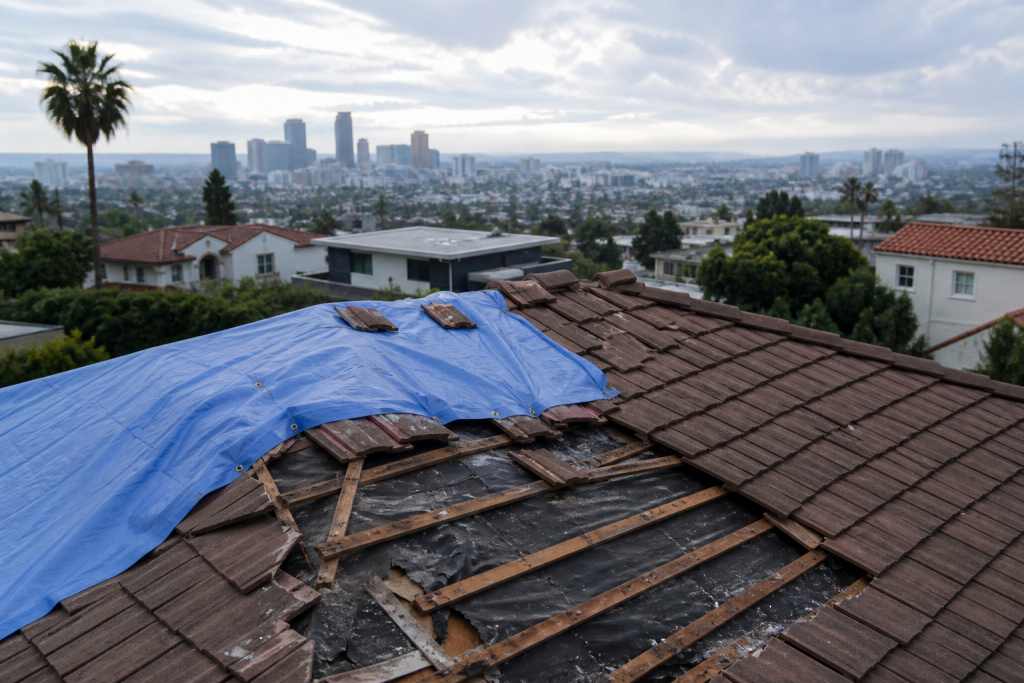
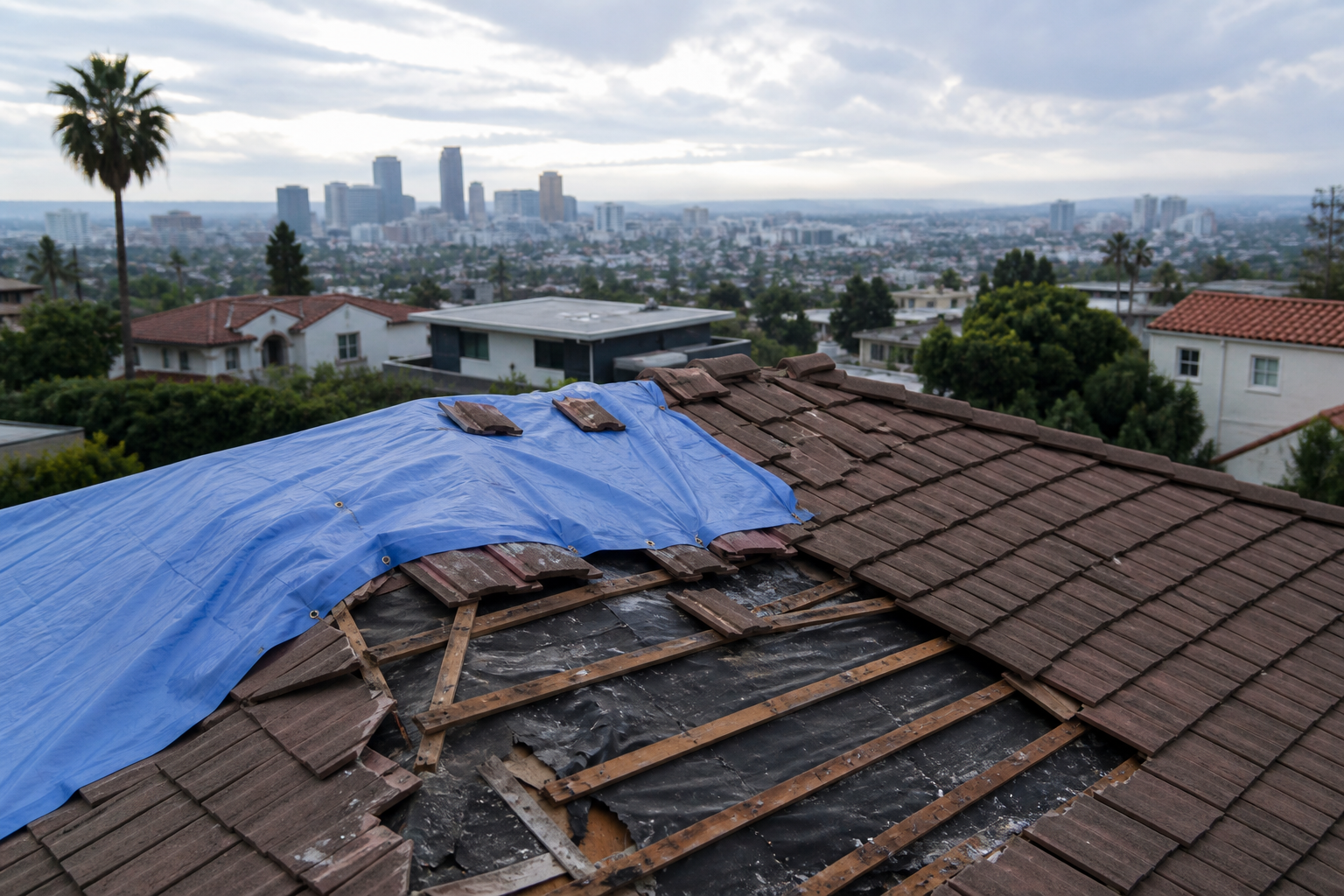
From the ground, you have two safe options. First, if you can see the damaged area clearly and it’s accessible from a second-story window or a flat section you can reach from a secure ladder, a heavy-duty tarp with 2×4 battens can buy you time. Roll the tarp over the ridge if possible, not just the damaged slope, so wind can’t lift it. Secure the edges with screws into the battens, not nails that pull out.
Second, and more practical for most Los Angeles homes, work from the attic if you have access. Place a tarp or heavy plastic sheeting on the inside of the roof deck, directly under the leak point. Staple or tape it to the rafters. This creates an interior watershed that channels water to your bucket instead of letting it soak insulation. It’s not pretty, but it works through the night until a crew arrives.
What doesn’t work: spray foam, caulk from the inside, or that rubberized coating you saw at the hardware store. These create a mess that makes proper repair harder and can trap moisture against the deck, causing rot. We’ve scraped plenty of homeowner “fixes” off decks in Silver Lake and Mid-City. They always cost more to remove than they saved.
What to Say When You Call a Contractor at 10 PM
The phone call matters. What you ask determines whether you get a local crew with a real warehouse and training program, or a call-center service that dispatches whoever answers their app that night.
Here’s the screening we recommend:
- Ask where their office is. A real Los Angeles roofing company has a real address. Storm chasers use PO boxes or hotel rooms.
- Ask for their CSLB license number and the name on the license. Write it down. We’ll explain how to verify it in the next section.
- Ask if they employ their crews or use subcontractors. There’s nothing wrong with subs, but a company with trained, uniformed employees has skin in the game. We hire local crews and train apprentices into journeymen because we plan to be here in thirty years.
- Ask what “emergency service” actually means. Some companies charge double for after-hours calls. Others, including Ridgeline, staff live phones 24/7 because emergencies don’t wait for business hours, but our pricing doesn’t punish you for the timing.
What not to say: “I’ll pay anything, just get here.” Desperation attracts predators. Get a clear description of what they’ll do when they arrive, what it costs, and what happens next if the weather won’t allow a full repair.
Emergency Tarp vs. Emergency Repair: Know What You’re Buying
These are different services with different prices and different insurance implications. Los Angeles homeowners often confuse them, and some contractors don’t clarify because confusion sells.
An emergency tarp is exactly that: a waterproof cover secured over the damaged area to stop active water intrusion. It does not fix anything. It buys time, typically one to six months depending on weather. In Los Angeles, where rain comes in concentrated winter bursts, a good tarp job can last through the season. Costs typically run $200-$600 for a standard residential section, depending on roof pitch, height, and how many tiles or shingles need removal to secure the tarp properly.
An emergency repair addresses the actual failure: replacing damaged underlayment, sealing penetrations, replacing broken tiles or shingles, or patching a small deck section. This restores the roof’s function and may satisfy your insurance policy’s requirement for “reasonable temporary repairs.” Costs vary widely based on access and materials, but most minor emergency repairs in Los Angeles fall between $400 and $1,200.
Your insurance adjuster will want documentation of whichever route you choose. Tarp jobs should include photos of the damage underneath, the tarp installation, and a written scope of what was covered. Emergency repairs need itemized invoices showing materials and labor separately. We document every roof repair in Los Angeles with photos from your actual roof, not generic stock images, because adjusters and homeowners both deserve to see what was done.
How to Spot and Avoid Storm Chasers in Los Angeles
Los Angeles doesn’t get hurricanes, but we do get named weather events - atmospheric rivers, Santa Ana wind events, even the occasional tropical storm remnant. After each one, out-of-state contractors descend on affected neighborhoods with magnet signs on rental trucks and promises of fast, cheap work.
Storm chasers know three things: how to knock doors, how to collect insurance checks, and how to be gone before the callbacks start. They don’t know your local building codes, your neighborhood’s typical roof systems, or where to find matching Atlas or Tamko shingles that blend with a 1980s Tarzana tract home.
Here are the three fastest ways to verify a contractor before they climb your roof:
- Check the CSLB license online. Go to cslb.ca.gov, enter the license number, and confirm the business name matches what they gave you. Verify the status is “Active” and the classification includes C-39 Roofing. Check for pending disciplinary actions.
- Confirm local presence. A Los Angeles roofing company should have a local phone prefix, a physical address you can verify on Google Street View, and a history of reviews that predates the most recent storm. We pulled one out of a garage over in Northridge last month where a storm chaser had “repaired” a valley leak with spray foam and left a $3,800 invoice. The homeowner found us through a neighbor who’d used Ridgeline since 2019.
- Ask about manufacturer authorizations. Legitimate contractors have relationships with manufacturers. We’re authorized installers for seven leading brands, including IKO, Boral, and the others we listed earlier. Storm chasers buy whatever’s cheapest this week.
The 90-Day Done Right Promise only matters if the company will still exist in ninety days. We’ve been here since 1984. That promise has teeth because we’re not going anywhere.
When to Call a Professional
Call when water is actively entering your living space, when you can see daylight through the roof deck, when a tree or large branch has struck the structure, or when you’re simply not comfortable assessing the situation yourself. There’s no shame in that. Roofs are high, heavy, and complex. We’ve spent forty years learning to read them safely.
If you’re in Los Angeles and need help, our roof repair team is available. We also handle full replacements and specialty systems when the damage goes beyond a simple fix.
The Bottom Line
The first hours after a roof emergency are about containment, not perfection. Move your belongings, control the water flow, document everything, and verify who you’re hiring before they arrive. Los Angeles weather gives us long dry spells that hide problems and sudden storms that expose them. The homeowners who fare best are the ones who act quickly inside the house and carefully on the phone.
If your roof is leaking now, or if you want a professional inspection before the next storm, Ridgeline Roofing Co. of California offers free estimates. A live person answers every call, day or night, including weekends and holidays. Call (877) 367-1429 and we’ll get someone out to you fast - with a written scope, upfront pricing, and the understanding that we’re not done until it’s done right.
Frequently Asked Questions
Emergency tarp jobs typically run $200-$600, while actual repairs addressing the underlying damage usually fall between $400 and $1,200 depending on roof height, pitch, and materials needed. Complex repairs involving deck replacement or multiple broken clay tiles can exceed this range. Call (877) 367-1429 for a free, exact quote - our estimates come with no surprises, and the price we quote is the price you pay.
Yes, most established Los Angeles roofing companies offer same-day response for active leaks, though true emergency repairs depend on weather conditions and crew availability. Tarp installations can usually happen regardless of rain; full repairs often wait for safe working conditions. At Ridgeline, we answer live 24/7 and dispatch based on urgency and safety - call (877) 367-1429 to check current availability in your neighborhood.
Homeowners insurance typically covers sudden, accidental damage from events like falling trees or wind-driven rain, but not damage from long-term neglect or normal wear. The key is documentation: photos of the damage, timestamps, and proof that you took reasonable temporary measures to prevent further loss. We document every inspection with photos from your actual roof to support your claim - call us at (877) 367-1429 and we’ll help you build the file your adjuster needs.
If the damage is isolated to one area, affects less than 25% of the roof surface, and your roof is under fifteen years old, repair is usually sufficient. Widespread damage, multiple leak points, or a roof near the end of its service life often makes replacement the better investment. We offer free second opinions on any written estimate, and our inspections include photo documentation so you can see exactly what we’re seeing. Call (877) 367-1429 to schedule - estimates are free, and there’s no pressure to decide on the spot.
Written by the team at Ridgeline Roofing Co. of California, serving Los Angeles since 2014.
Need Roofing Help?
Call Ridgeline Roofing Co. of California - licensed & insured, here with fast after-hours help in Los Angeles.
(877) 367-1429