
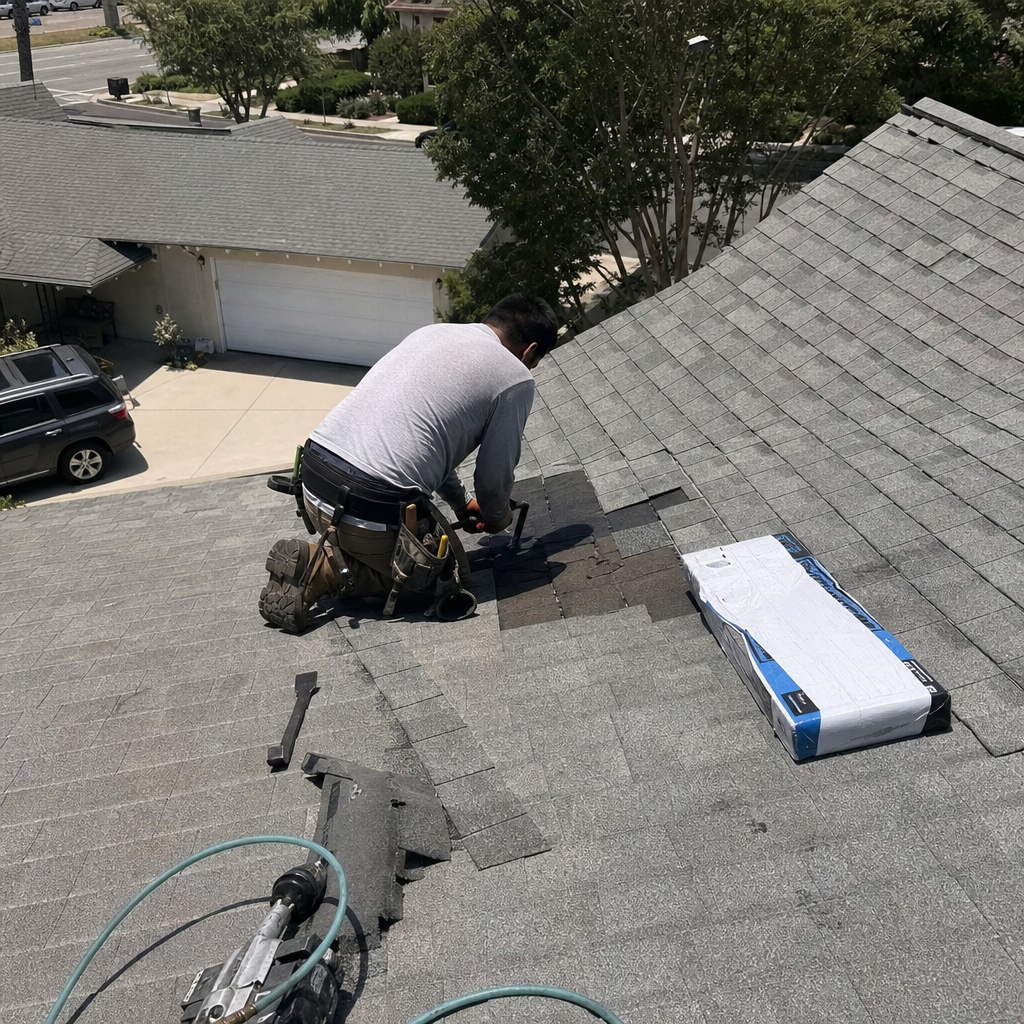
CertainTeed Ridge Vent Installation: The California Owner’s Guide
We stock and install CertainTeed-compatible ridge vent systems across California, with most residential installations running $1,200-$2,800 depending on ridge length, roof pitch, and whether we’re matching existing CertainTeed shingles. Same-day installation is available when you call before noon, and we carry the full CertainTeed ridge vent line on our trucks. Most California homeowners discover their ridge vent has failed during our seasonal tune-ups or after noticing their attic has turned into a sauna in July, their shingles are curling prematurely, or they’ve spotted daylight peeking through the ridge line from inside the attic.
Which CertainTeed Models This Applies To
CertainTeed’s ridge vent ecosystem breaks into three main families, and matching the right one matters more than most homeowners realize. The CertainTeed Ridge Vent (standard roll vent with external baffles) pairs with Landmark, Landmark PRO, and NorthGate shingle lines. The CertainTeed Intake Vent system works as a matched set with their ridge vent for full attic ventilation. The CertainTeed Cedar Crest and Grand Manor luxury shingle lines require a wider ridge cap profile, and standard roll vent won’t seat properly.
Here’s how to identify what you’ve got: check the shingle label strip left in your garage from the original installation, measure your ridge board width (most California tract homes built 1960-1990 run 1.5 to 2 inches), or look for the CertainTeed logo embossed on existing ridge cap shingles. We carry OEM CertainTeed ridge vent and matching ridge cap shingles on every truck, plus quality aftermarket equivalents from Air Vent and Lomanco for older systems where CertainTeed has discontinued the exact profile. The aftermarket decision usually comes down to whether your existing shingles are still available for a seamless match, or whether we’re blending a new ridge vent into weathered roofing where perfect matching isn’t possible anyway.
One compatibility gotcha we see regularly in California: CertainTeed’s Mountain Ridge vent, popular in the 2000s, used a 12-inch-wide roll that conflicts with California Title 24 energy code requirements for net free area in certain climate zones. If your home falls in CA Climate Zones 8-15 (coastal and inland valley regions including much of Los Angeles, Orange, and San Bernardino counties), that original Mountain Ridge may not meet current code on a full replacement. We check this during every estimate.
Signs Your CertainTeed Ridge Vent Installation Is Failing
- Attic temperatures spike 20-30 degrees above ambient. A properly vented California attic should run within 10-15 degrees of outside air. When the ridge vent’s internal baffles clog with dust or the end caps separate, hot air stalls instead of escaping. We measure this with a laser thermometer from the attic hatch.
- Premature shingle curling or granule loss along the ridge. Heat and moisture trapped by a failed vent bake the shingles from underneath. In California’s inland valleys where summer attic temps can hit 160°F, this accelerates dramatically. The damage pattern is distinct: curling starts at the ridge and works downward, unlike wind damage which shows randomly.
- Visible gaps or lifted sections along the ridge line. CertainTeed’s ridge vent uses a nail flange system that can work loose after 15-20 years of thermal cycling. California’s dry heat followed by winter rain expansion creates this exact failure mode. From the ground, you’ll see waviness or shadows where the vent profile has separated from the deck.
- Water stains on ceiling drywall near the ridge. When end caps crack or the vent itself shifts, wind-driven rain enters at the highest point of your roof. In California’s occasional heavy winter storms, this shows up as isolated ceiling spots directly below the ridge, often mistaken for flashing leaks.
- Pest intrusion in the attic. Squirrels and roof rats exploit separated ridge vent sections, particularly in California’s oak woodland interface areas. The vent’s plastic baffles make tempting chew points once the adhesive seal degrades. We find nests built directly inside failed vent runs several times each season.
Replacement Cost & What’s Included
In California’s current market, a full CertainTeed ridge vent replacement runs $1,200-$2,800 installed. Here’s how that breaks:
- Short ridge (under 40 linear feet), single-story, standard pitch: $1,200-$1,600
- Medium ridge (40-70 feet), two-story or steeper pitch: $1,700-$2,200
- Long ridge (70+ feet), complex hip-and-ridge geometry, or luxury shingle match: $2,300-$2,800
What drives the range: ridge length is obvious, but roof pitch matters more than people expect. A 6/12 pitch we can walk; a 10/12 requires staging and moves slower. The shingle match is the other variable. If your CertainTeed Landmark shingles are six years old and still stocked, we match exactly. If they’re discontinued or severely weathered, we discuss whether to re-ridge the entire roof line for consistency or blend as close as possible.
Every installation includes removal of the failed vent, deck inspection and repair of any soft spots, new CertainTeed or matched aftermarket ridge vent, matching ridge cap shingles, end caps, and sealant. The work is covered by our 90-Day Done Right Promise - written, no paperwork runaround, no arguing. If it’s not right, we come back and make it right. We also document the completed installation with photos from your actual roof, uploaded to your customer file.
California homeowners should know: proper ridge vent installation qualifies for extended manufacturer warranty coverage when paired with CertainTeed’s full system components. We register this paperwork for you.
DIY or Call Us?
There’s a honest line here, and we’ll draw it plainly. A homeowner can safely check attic temperature with a thermometer, look for visible gaps from the ground with binoculars, and photograph anything suspicious for us to review. What we don’t recommend is ladder work on a pitched roof to inspect the ridge itself, or attempting to remove and replace a ridge vent. The ridge is the highest, most exposed point of your roof. One misstep on a 7/12 pitch with morning dew, and you’re in the ER instead of finishing the job. The nail gun work at the ridge also requires consistent pressure and proper shingle overlap that looks simple until you’re balancing 20 feet up and the wind picks up.
We’ve pulled apart DIY ridge vent jobs in Burbank, Torrance, and Pasadena where the homeowner got the vent on straight but missed the end cap sealant, or used roofing nails instead of the specified ring-shank fasteners, or simply didn’t have the hip-and-ridge cutting experience for a clean profile. Each of those “savings” became a callback within two years. If you’re weighing the decision, call us at (877) 367-1429 for a free estimate. The number we quote is the number you pay, and most jobs finish in a single visit.
FAQs
A properly installed CertainTeed ridge vent typically lasts 20-25 years in California’s climate, though inland valley installations with extreme heat cycling may see 15-20 years before baffle degradation. Coastal installations with salt air exposure can see faster corrosion of metal components if present. We inspect ridge vent condition as part of our $89 Seasonal Tune-Up. Call (877) 367-1429 to schedule.
Spot repairs are possible for isolated issues like a single lifted end cap or a small section of separated nail flange, but they’re usually temporary fixes. Once the vent material has aged to brittleness, which we check by hand-flexing a sample piece, replacement of the full run is the only reliable solution. We don’t sell half-measures that leave you calling again next season. Call (877) 367-1429 and we’ll show you exactly what we’re seeing on your roof.
Most residential CertainTeed ridge vent replacements take 4-6 hours from arrival to cleanup, with larger or steeper roofs extending to a full day. We complete 90% of these jobs in a single visit because we stock the full CertainTeed line and matching ridge cap shingles on every truck. You’ll know the timeline before we start. Call (877) 367-1429 for scheduling.
Yes. We carry CertainTeed standard ridge vent, Mountain Ridge, Intake Vent components, and matching ridge cap shingles in every service vehicle. We’re also authorized installers for GAF and Owens Corning systems if your roof has mixed manufacturer components. Same-day installation is available on most calls placed before noon. Call (877) 367-1429 to confirm stock for your specific model.
A roof doesn’t lie. Sooner or later it tells you exactly what it’s made of. When your CertainTeed ridge vent starts talking, we’re the ones who listen properly, diagnose honestly, and fix it so you don’t have to think about it again.
Ridgeline Roofing Co. of California is an independent service provider and is not affiliated with CertainTeed Corporation. We are, however, authorized to install their products and have done so on California roofs for over four decades.
Ready to get this handled? Call (877) 367-1429 now. A live person answers 24 hours a day, including nights, weekends, and the middle of a storm. We’ll schedule your free estimate, confirm your CertainTeed model compatibility, and in most cases complete the installation same-day or next-day. The price we quote is the price you pay. Done right - and if it’s not, we make it right.
Written by Cole Drummond, Owner, Ridgeline Roofing Co. of California at Ridgeline Roofing Co. of California, serving California and nearby areas.